The Doctor And The People
Publisher: Methuen
Format: Hardback
ISBN: none
There was a time when the family doctor was expected to be considerably more than a medical professional. He was a confidant, counsellor, emergency visitor, amateur detective and occasionally the unfortunate recipient of an invitation to inspect something unpleasant that had been developing beneath a patient’s waistcoat. All this was generally accomplished without antibiotics, modern diagnostic equipment or the reassuring possibility of consulting the internet. It was, by any reasonable standard, a demanding occupation.
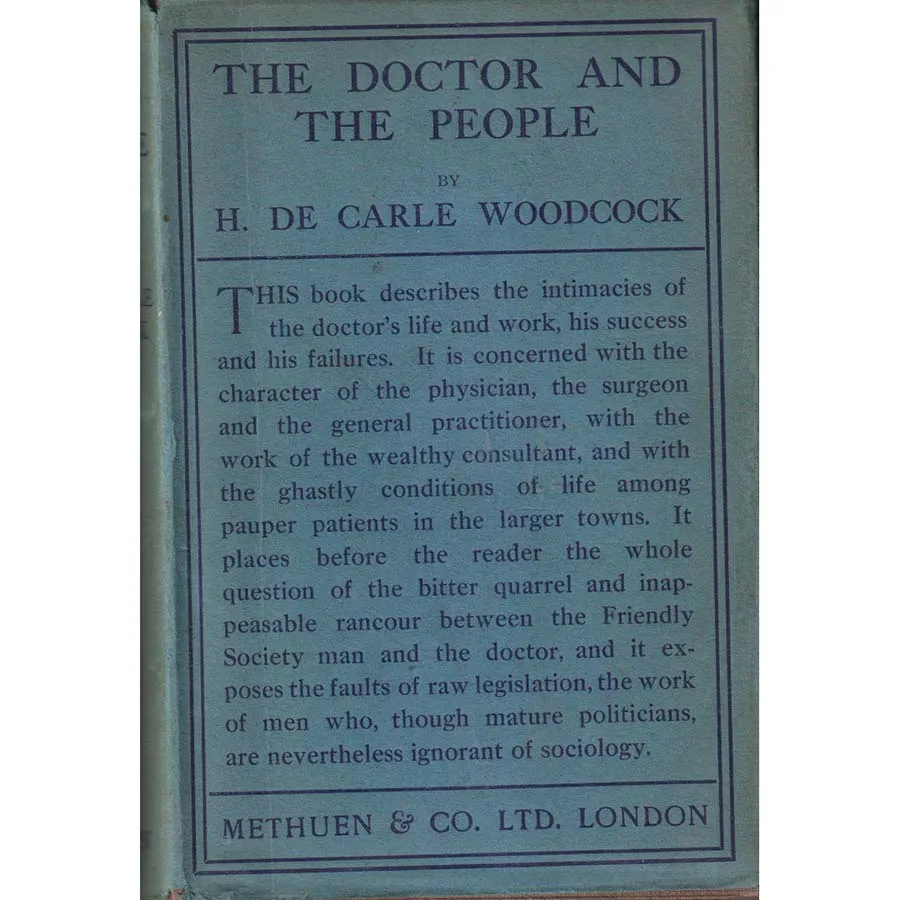
Hardback with dust jacket.
The Doctor and the People (1912), by H. de Carle Woodcock and published by Methuen, offers a fascinating glimpse into the world of British medicine at the beginning of the twentieth century, when medical science was advancing rapidly but the everyday realities of illness, poverty and professional practice remained decidedly complicated.
Woodcock was himself a physician, and his observations carry the authority of someone who understood that the practice of medicine involved rather more than prescribing remedies and looking impressive in a waistcoat. Through a series of essays, he examines the relationship between doctors and their patients, the organisation of medical services, the responsibilities of the profession and the often uncomfortable social circumstances surrounding illness.
Among the subjects explored are the contrasting worlds of fashionable consultants and doctors serving poorer communities, the realities of hospital and dispensary work, public health legislation, tuberculosis and the challenges of providing medical assistance to those least able to afford it.
The contrasts are particularly revealing. At one end of society were patients who could summon a distinguished physician to investigate a troublesome digestion; at the other were families confronting infectious disease, overcrowded housing and poverty, often with considerably fewer resources than their illnesses required.
Woodcock approaches his subject with professional experience, social observation and occasional flashes of humour, revealing a medical world in which scientific progress and human prejudice existed in an uneasy partnership. His perspective is unmistakably that of his time, making the book valuable not only for what it explains about medicine but also for what it reveals about the attitudes and assumptions of Edwardian society.
Published in 1912, just before the First World War transformed British society, this volume provides an absorbing historical snapshot of healthcare before the National Health Service, when access to treatment was shaped by class, income, charity and a complicated assortment of medical institutions.
Readers interested in the history of medicine, social conditions, public health or the everyday realities of Edwardian Britain will find much to explore. It is also an intriguing reminder that arguments about healthcare provision, medical costs and professional responsibilities were flourishing long before anyone thought of establishing a government website to explain them.
Condition: Good. An antique volume showing ordinary signs of age and handling, but surviving remarkably well considering that it has existed through two world wars, numerous medical revolutions and more than a century of people being advised to take things easy.
Offered by Crappy Old Books, where we cannot provide a diagnosis, write a prescription or guarantee that reading medical history will improve your constitution. We can, however, offer an entertaining historical consultation without the necessity of removing your shirt.
No ISBN, naturally. In 1912, books were apparently expected to manage without one.
Keep browsing: See more Non-Fiction books Other books by Carle Woodcock